Mostrando postagens com marcador coup. Mostrar todas as postagens

quarta-feira, 26 de julho de 2017

Brazil hikes mining royalties to ease budget deficit

Image result for brazil temer
Brazil unveiled plans on Tuesday to raise revenue from mining royalties by 80 percent, the latest measure to shore up government finances, and cut red tape in attempt to attract more foreign investment amid a weak economic recovery.

President Michel Temer, at the policy launch in the presidential palace, said that this fit into his broader plans to modernize regulation across sectors to draw investment and boost the economy.

"We are just scratching the surface here," Mining Minister Fernando Coelho Filho said, touting Brazil's potential to grow as a mining powerhouse if the government reduces red tape.

"These measures will be fundamental to speed up the growth of the Brazilian economy," he added, defending changes to outdated royalties and clearer rules for mining investors.

While some in the sector voiced support, mining industry body IBRAM, which counts Brazil's largest miner Vale as a member, criticized the policy, saying there was no way to cut costs enough to offset the higher levies.

"Mining companies feel pressured to pass on this new cost increase to the industrial production chain," it said in a statement. "This new condition will increase the risk of loss of competitiveness in the international market for ores."

Brazil's slow economic recovery has weighed on tax revenue, forcing the government to find new sources of funding. Last week, the government said it would raise taxes on fuel and increase a public spending freeze by 5.9 billion reais ($1.9 billion) this year.

Temer announced the first changes to the mining code since the early 1990s via a temporary presidential decree, which will require approval from Congress within 90 days. The royalties would go into effect in November, if approved, while other rule changes take effect immediately.

Royalties will increase by a set rate on diamonds, gold and other materials, while iron royalties will increase in tandem with the price of the mineral, gradually rising from 2 percent if the market price is less than $60 per tonne to a maximum of 4 percent if the price rises above $100 per tonne.

Raw materials used directly in construction would see royalties fall to 1.5 percent.

The royalties will be calculated on gross sales revenue, rather than net sales previously, significantly raising the base of calculation.

The government will also create the National Mining Agency to replace the National Department of Mineral Production that officials said would increase transparency and reduce bureaucracy.

Environmental licenses to miners are issued in four years in Australia but 10 years in Brazil, Coelho said, giving an example of red tape that must be reduced.

Higher Fines

The reforms could help attract billions of dollars in venture capital to Brazil's mining sector by creating an investor-friendly environment, said Ana Cabral-Gardner, a board member at miner Sigma Lithium and veteran mining banker.

"Previously a deadly regulatory combination of arcane rules, lack of transparency and opacity discouraged large established global investors," she said.

The measures would also increase fines for environmental damage up to a ceiling of 30 million reais ($9.47 million) and expressly require companies to clean up degraded areas. Brazil is still recovering from the 2015 Samarco mining disaster, in which a tailing dam burst and unleashed enough mud to fill 12,000 Olympic swimming pools.

Source: Reuters

sexta-feira, 3 de fevereiro de 2017

Brazil's Temer lifts infrastructure aide to ministry post

Brazil's Vice President Michel Temer (L) listens to Moreira Franco during a meeting with members of the Party of the Brazilian Democratic Movement (PMDB) in Brasilia May 7, 2015. REUTERS/Ueslei Marcelino
Brazilian President Michel Temer elevated his infrastructure investment secretary to a ministry-level position on Thursday, granting a degree of legal protection to a trusted confidant implicated in a sweeping corruption investigation.

Wellington Moreira Franco, a close adviser to the president, will also be responsible for communications and ceremonies, the presidential spokesman told journalists. He will retain his infrastructure role at Cabinet level.

The promotion highlighted Temer's confidence in Moreira Franco, who, according to a source, had drafted a resignation letter in December after plea bargain testimony in a major graft probe implicated him in illegal campaign fundraising.

Moreira Franco denied any wrongdoing or intentions to quit. His new position in Temer's Cabinet means any case against him must be tried by the Supreme Court, which has a long backlog of cases.

Temer's spokesman also said the president was appointing lawmaker Antonio Imbassahy as his minister in charge of relations with Congress, replacing Geddel Vieira Lima, who stepped down in November amid allegations of influence peddling.

The appointment of Imbassahy, one of five ministers now from the Brazilian Social Democracy Party, or PSDB, in Temer's Cabinet, reflects the president's growing dependence on the allied party to pass economic reforms aimed at closing a huge budget deficit.

The PSDB has pledged to support the government through 2018, when both they and Temer's own Brazilian Democratic Movement Party, or PMDB, plan to field their own presidential candidates.

Given the tensions in some corners of the two parties, Temer waited to announce Imbassahy's appointment until an ideological ally of his was confirmed as speaker of the lower house of Congress earlier on Thursday.

Temer's spokesman also said the president was recreating a Ministry of Human Rights, reversing his decision last year to shutter the ministry and pass its responsibilities to his justice minister.

Temer appointed as human rights minister Luislinda Valois, another member of the PSDB and the first black woman to serve as a judge in Brazil.

Source: Reuters

sexta-feira, 23 de setembro de 2016

Brazil's new president promises investors political stability

President Michel Temer of Brazil addresses the 71st United Nations General Assembly in Manhattan, New York, U.S. September 20, 2016. REUTERS/Carlo Allegri
Brazilian President Michel Temer on Wednesday promised political stability for foreign investors to put their money in a country weathering the impeachment of his predecessor and the worst recession in generations.

Speaking for the first time to investors in New York, Temer said he was confident he will have enough backing in Congress to pass unpopular fiscal reforms needed to plug a ballooning budget deficit and regain the confidence of markets in the once-booming economy.

Temer, formally sworn in three weeks ago, has managed to approve minor bills in Congress after months of political turmoil that led to the impeachment of his leftist predecessor Dilma Rousseff.

However, the 75-year-old constitutional scholar is already facing divisions within his widely diverse alliance in Congress with some lawmakers promising to water down the fiscal reforms.

The head of his economic team, Finance Minister Henrique Meirelles, told investors at the same event that he saw "extremely high chances" of approval for a key proposal to cap public expenditures.

Meirelles said a controversial reform to reduce generous pension benefits and set a minimum age of retirement will most likely be approved next year.

The proposed reforms and management changes in key state-run enterprises are shoring up confidence in Brazil that is on track for a gradual recovery after two years of recession, Meirelles said.

"Our actions aim to reduce the debt burden and increase productivity," Meirelles said.

He added that the government could consider selling debt abroad again this year if market continues remain favorable.

Temer, who was in New York to address the U.N. General Assembly, on Tuesday assured world leaders at the gathering that the dismissal of Rousseff was fully constitutional. However, delegations of some leftist governments walked out of the session to express their objections about his legitimacy.

Source: Reuters

quarta-feira, 21 de setembro de 2016

Syrian war tops UN Assembly Agenda

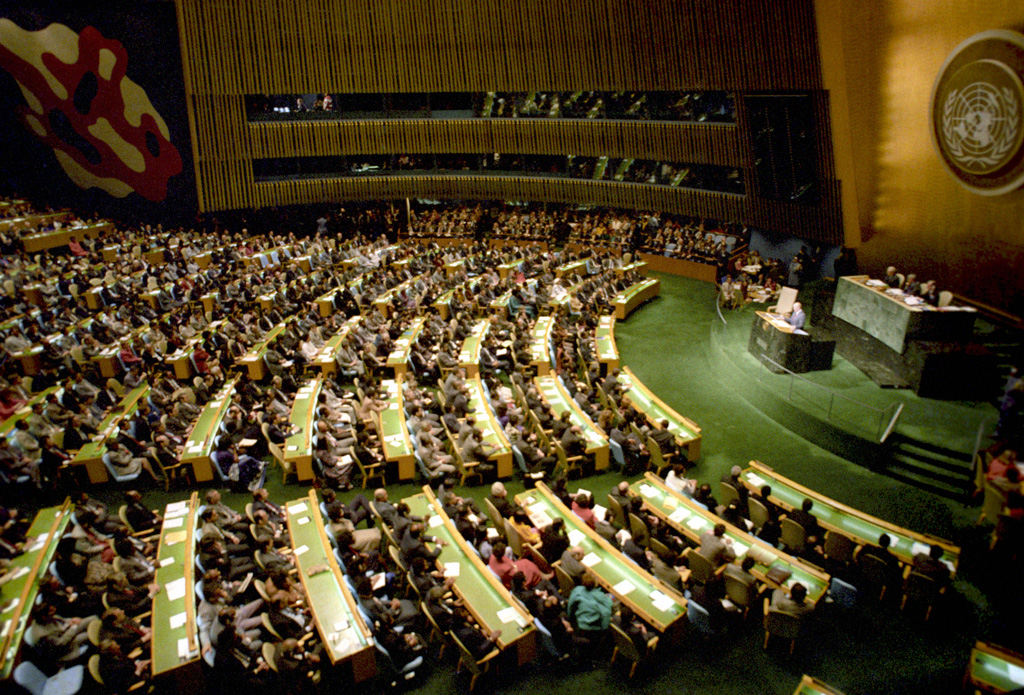
Image result for UN General Assembly
The UN General Assembly Wednesday hosted a high-level summit calling for an end to the long and bloody Syrian war and to recover the value of diplomacy, despite recent tensions between the US and Russia.

"Present in this hall today are representatives of governments that have ignored, facilitated, funded, participated in or even planned and carried out atrocities inflicted by all sides of the Syria conflict against Syrian civilians," said UN Secretary-General Ban Ki-moon in front of 193 participating nations.

He has also accused the Syrian government of killing innocent civilians during the brutal Syrian war and said "powerful patrons that keep feeding the war machine also have blood on their hands."

As the half-century tradition, Brazil spoke first at the UNGA. However, when Michel Temer started to talk, some Latin American delegations decided to leave the room.

While President Michel Temer made his UNGA debut, this was the last time US President Barack Obama, who will leave office in January 2017, addressed the UN as the US president.

Like Ban, Obama said "there's no ultimate military victory to be won" in the Syria conflict, instead "the hard work of diplomacy" is needed to end the violence.

However, the US leader accused Russia of trying to recover "lost glory through force."

Obama cautioned that "if Russia continues to interfere in the affairs of its neighbors," such actions will "make its borders less secure."

French President Francois Hollande, also asked that those intervening in the Syrian war reaffirm their commitment to peace, telling the UN "enough is enough."

Theresa May, Britain's new prime minister in her first speech before the UNGA, called for international efforts to end the Syrian war.

Source: EFE